terrychapman


Some things don’t need fixing.  Witness “New Coke” in Atlanta about 25 years ago — somebody thought they could fix Coca-Cola.  Duh!!  How would you improve a ’57 Chevy?  Did anybody give Elvis singing lessons?  Who would have stopped Fred Astaire and Ginger Rogers and said “Wait, you’re doing that all wrong: you dance backwards and let her dance forward, and by the way, lose the top hat and cane.”?

I have been working on a Shaker Candle Stand the last few days and I Googled it for some reason.  Do you know how many people think they can improve on the original?  Listen, Homer, it is done.  It is completed.  Do not sit down and say, “I think I will re-design the Shaker Candle Stand — I can do better.”

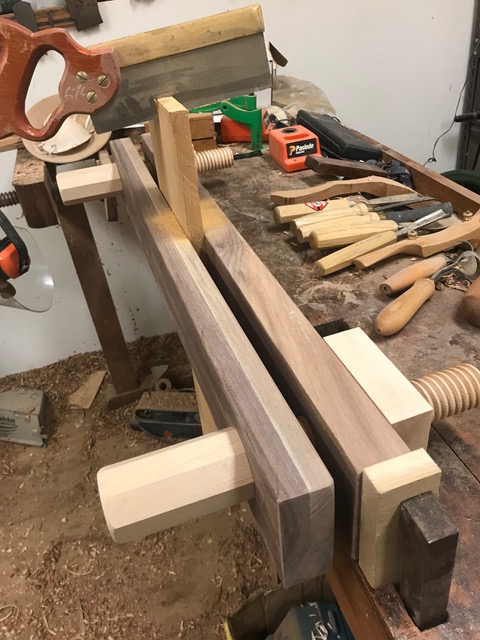
My Candle Stand

You cannot add ball and claw feet to this thing.  You cannot carve deep philosophical thoughts into the top of it.  Do not add fancy gingerbread brackets to the underside of the table.  If you simply cannot resist, then go carve clown faces in your hope chest.  The candle stand was completed 200 years ago and it is done.  I don’t have a problem with trying to improve your technique, make the dovetails better, upgrade your skew skills on the post, that sort of thing.  But nobody has improved on it in 200 years and I can tell you, Ralph, you are not going to help it.

Go watch the Roy Underhill video on making one of these babies and listen to St. Roy expound on the shape of that marvelous center post.  I love this little table, it is probably my favorite thing to try to make and I have parts of one going nearly all the time in my shop.  The dovetails are difficult for me, but I will get better.

Hancock Shaker Village Table

A couple of years ago I went to New England to take a class and while there I went by the Hancock Shaker Village for a tour.  They have a beautiful Candle Stand there and it is the one I try to make each time.  If my effort does not match this beautiful example, it is a lack of skill on my part, not because I think I can improve on it.

What do you think?  Let me hear from you.


Everybody needs their own gargoyle.

I bought some basswood at the wood store a few months ago and about two weeks ago, went to the High and got a six piece set of Flexcut carving tools.  I found a pattern I like in a book and decided to go after it.  After roughing it out on the band saw, I went after it with the carving tools.  I really like it.

Just off the Band Saw – what do you think?

Still a ways to go, but not too bad for the first gargoyle.  Least it’s not rock.

One Side Roughed Out
 

I have been thinking about dipping into spoon making (Wow, did anybody not see that one coming?) for a long time.  A couple of months ago, I finally did it and I think I like it.

Several things got me started — Peter Galbert on his website shows how he makes spoons during those long cold winter nights by the fireplace up there in far north Massachusetts.  Then he sells them to benefit a favorite charity.  Go to http://chairnotes.blogspot.com and search for spoons in the list at the bottom right or click “Spoons for Hunger” at the top right of his page.  His spoons are beautiful and painful to me as I am reminded of how far I have to go.

Another source for spoon making ideas is Robin Wood in England.   Go to http://www.robin-wood.co.uk/ and see what he has to offer.   If I lived in England and did wood working, I would call myself Robin Wood.  I love his bowls, too.  He uses a foot-powered lathe to make bowls and you saw them in that recent Robin Hood movie with Russell Crowe, the one with the medieval wooden Higgins boats the French used to invade England.  I laughed out loud.  Robin gives classes and next time you cross the pond, you can sign up.  He does beautiful work which is also painful to me.

Try Roy Underhill’s “The Woodwright’s Shop” for his current season show #3108 with Peter Follansbee on carving Swedish spoons.  The main thing I learned from this one is to use green wood (duh!).  I mean I did not get that when I started.  I was picking up old chunks of wood from around the shop and then dust was flying everywhere and I never got it done, and my admiration for spoon carving was rising all the time.  I was about to give it up as too hard and too much trouble when I watched Roy and Peter and they set me on the green wood path.

The fourth source is Drew Langsner over at Country Workshops in North Carolina.  Go to countryworkshops.org and check out his videos and maybe you can sign up for a class.

When I first started looking and learning, all the instructors used traditional tools to carve spoons.  You start out with an axe and then move to a carving knife and a curved hook knife, a spoke shave and anything else with a edge that will remove wood.  Took me about three days of effort before I discarded some of that junk.  I finally went to the band saw, a hand grinder and the spindle sander — anything to get that wood off there.  If I could make the chain saw do it, I would.

Splitting the spoon blank.

I had some green Bradford pear wood that I got when a tree blew over at the office.  I split it out to a suitable blank and sketched a shape I liked from one side and then from the top and put it on the band saw to get the basic shape.  I moved to the axe (from Highland) and a stump (from the yard) and started hacking away.  Surprising how much wood (or fingers) you can take off with an axe while still maintaining control of the work.  I found the trick to a good spoon is getting it thin enough to make it look delicate while leaving it thick enough to be strong.  I like a shape which is wide horizontally at the handle and tall vertically near the bowl.  The transition between the two is lovely when done right.

Roughed out on bandsaw

The tools I used are some I already had around the shop including the short axe, and a spoke shave.  The other odd group of tools is a set of Exacto hobby tools which are small and very sharp, and include a small spoke shave which is marvelous for final shaping, and a round head cutter sharpened on one side.  I went to Highland and bought two new tools which are really nice for the work.  One is a small carving knife which came very sharp with no need for honing.  It works like a champ.  The other is a curved hook knife which is used for hollowing out the bowl of the spoon.  I was surprised at how well that little knife worked.  You can see all the tools in the picture.

The single biggest problem is holding the work so you can carve on it.  Roy Underhill showed how you actually carve the bowl first since it is the hardest to shape.  Plus you can clamp the square handle in the bench vise so you can work the bowl.  I found there is a delicate balance between holding and carving, and eventually you end up holding the whole thing against your chest while you carve.  One of these days I will have to make a shaving horse which I think will work better without breaking the spoon.

Almost ready to go.

As I said, I am not proud and I will use any power tools I have to get the wood off.  I did learn to wrap the unfinished piece in kitchen plastic wrap to keep it from drying out until I get back to it the next day.  So far it takes me about four or five hours over a couple of day to get one done, but I think I will get faster.  I have done about four spoons so far and the last one was pretty good.  I had a bowl out of cherry that looked really nice and I noticed the spoon matched the bowl, even though they are different species.  It made a really nice bridal gift.

The bridal gift.

Think you might like to make a spoon one day?


Bet’cha can’t do this.  Not many people can cut a perfect arc on a table saw in a thin piece of plywood.  Notice how the cut is just the right depth to keep the ply together.  Notice how the cut starts in from the side perfectly tangential to the arc.  Notice how the cut continues all the way across the workpiece in a perfect arc.  Notice the small blood stain in the center of the piece.

Perfect Arc on the Table Saw

Maybe you have guessed by now this is a terrible mistake and a big screwup.  I was cutting some pieces of plywood for our annual family gingerbread house construction and I failed to pay sufficient attention near the end of the cut.  It got away from me in about one tenth of one second and the next thing I knew it was bouncing off the back wall of the shop about 15 feet behind me.  Thank goodness I was wearing a face shield and standing to the side as I always do.  The only damage, besides my ego, was a broken fingernail and a pretty good scrape to my ring finger from the flying plywood.  That thing took off like a helicopter, flew just past my head, all the way across the room and banged into the wall near the ceiling behind me.  It was brutal and scary and reminded me all over again how potentially devastating a moment of carelessness can be in the shop.

I am sure that many of you out there are looking at my saw and noting the lack of a guard and splitter at the blade.  You are right and I deserve that.  But for all you beginners out there, note this.  I am an experienced woodworker who has used a table saw for years and I know how this kind of kickback happens.  It happens because I took off the splitter behind the blade and the piece twisted and the back portion of the saw caught the wood and threw it back at me.  But you see, I was just going to use the saw for thirty seconds to make a base for a gingerbread house and it was not a real project,   and I know all about this stuff cause I write for Highland and I don’t need any advice from you.  That kind of thinking is what gets you hurt.  Leave the guard on your saw or at the very least, get an aftermarket splitter behind the blade.  And be careful out there.

By the way, the way you know you are pretty far gone is when something bad happens, all you can think is “Oh wow, that’s a great blog entry”.


Christmas is coming and it is time to look at the old wish list.  My family laments the fact that I have all the $30 woodworking tools.  Anything I still need/want is going to be more.  Assuming you have been a good boy or girl, perhaps it will be a fruitful year in the workshop.  For the sake of any of you friends and family (particularly my son Jon) who might be looking for something to grace this old blogger, here is my list for this year.  Maybe there is something you might like on my list.

1.   I would like to be able to write songs like Brian Wilson of the Beach Boys and sing like George Younce of the Cathedrals.  Oh wait, did you say this was a Wish List for a Woodworking store?  Sorry, those two just slipped out.

Steel City Hollow Mortiser

2.   Hollow Chisel Mortiser — Highland has a top notch power mortiser from Steel City for $299.99.  I saw it in the store this week and it is high on my list.  If you do a fair amount of mortise and tenon joints, then this tool may be just right for you.  It is bench mounted and has a rack and pinion adjustable fence for easy alignment.  The handle adjusts to six positions and is reversible.  The switch is right up front and easy to reach.  The bits lock into the spindle and there should be none of that twisted bits stuff which is so irritating on lesser models.  This thing looks like an excellent medium duty machine for the serious amateur mortise maker.

3.  ANYTHING from Festool.  I have not started my Festool collection yet, but these tools are always on my list.  Given my choice, I would start with the chop saw, then the router, and then the sanders with the vac.

Shaping a Rocker

When I was working on my rocking chair, Charles Brock in his shop had the heavy duty Festool sander hooked up to the Festool vacuum and it is a sweet operation.  Probably not going to happen this year, but perhaps if I am very, very good next year.

4.  Sawstop Table Saw —  Highland can ship the SawStop Contractor Saw to all the lower 48 states now and if you are looking at a table saw, you owe it to your spouse and family to keep all your fingers.  Touted as the safest table saw out there, don’t ask for any other saw without looking seriously at this one.  Watch the famous hot dog video, (or the chicken leg demo) and you will be a fan.

Fein Multimaster Tool

5.  Fein MultiMaster — I have seen the commercials on TV for this thing.  What really convinced me, however, was when the construction manager at my Habitat for Humanity chapter pulled one of these out of his truck.  We needed to notch out a board to set a marble counter top, and there was no good way to do the work without tearing half the wall down.  We turned this thing on and in about 30 seconds, the job was done.  Be careful, though because there are many lower-quality imitators out there, ranging from the $29.95 version at the tool discount store to somewhat more expensive models from some of the major manufacturers.  The real thing may seem a little pricey, but it is worth every penny.  Also do some research on the blades, because there is a very wide range of quality available in blades and they can be a costly error if you get the wrong ones.  The Fein Multimaster model I would like is the FMM 250Q Select Plus kit, which until recently sold for $329, but is available at Highland right now for $299.  It should do almost all I need right now, and I can always buy accessories for it as I need them.

6.  Auriou Chairmaker’s Rasp Set — If you have never used one of these things and all you have ever tried is one of those five dollar rasps from the local hardware, then you are in for a revelation.  I had never used one of these things until I worked on a sculptured chair.  Who knew that the single biggest issue with one of these beautiful tools is you have to be careful to not remove too much wood.

Auriou Chairmaker's Rasp Set

How many hand tools do you use where taking off too much wood is the main problem?  Most of the time, I have trouble just getting tools to cut in the first place.  Well, you say, I sure as heck ain’t paying that much money for a stupid rasp.  Well, nay, I say, nay!  First of all, these rasps will last the rest of your life and your children will bless you for them.  Second, once you try them you will wonder how you missed them your whole woodworking life.  Just try one and you will agree with me.  (By the way, Jon, I like the set of three for $349.99.)


There you go.  Slide this list under the door for somebody, or leave it open on the computer.  Or print it out and leave it under the breakfast cereal.  If you don’t score any of these things this year, try being gooder next year.  I’ll let you know how it worked out for me.


A few months ago, I posted some videos of my wood turning efforts with the Easy Wood Tools. These tools are fairly new at Highland and I wanted to give them a try. I started with the Large Rougher which has a rectangular tip on it and has turned into one of my favorites especially when starting a project. You can move a lot of chips quickly and easily. In fact I would venture to say it is excellent for a beginner who wants to jump into turning and produce something immediately on the lathe.

The next month I moved to the Easy Finisher and made a video of that one showing less success. The tip on the Easy Finisher is round and like all the others is very sharp. Unfortunately, I let some ingrained habits take over and violated some of the rules put forth by the manufacturer for using these tools. I blew one small bowl apart and then got a nasty catch (is there any other kind?) as I was working on a larger walnut bowl. My conclusion was that I needed more practice and that perhaps the Finisher should be named the “little bit harder to use” tool.

As it turns out, the people from Easy Wood Tools were watching and got in contact to offer some suggestions. At the time, Rory Curtis was the National Director for Easy Wood Tools and called to offer some suggestions.

He suggested first of all that the best grip is to have your thumb on top of the tool and your finger underneath. Using that grip leads directly to Rule #1: Flat on the tool rest. Now if you are a beginner and have never learned to use a bowl gouge, that grip is easy. If like me, you spent many hours learning that delicate little compound curve motion to move from the edge of a bowl to the center with a conventional bowl gouge, then you will find you have to make a conscious effort to keep the Easy Tool flat on the rest. Keeping it flat is critical.

Rule #2: Level to the floor. That one is different too. Not many of my other tools are used level to the floor. That same compound curve motion from Rule #1 that takes months to learn with other tools can lead you wrong with Rule #2. My instinct is to constantly adjust the angle of the gouge as I feel the bevel and watch the cutting edge. It is hard to get away from long established habits, but when you come off level with the Easy Tools, bad things happen.

Rule #3: Set the tool rest so the top of the tool is even with the center of the work piece. This one is not much different from what I normally use. I do set the tool rest a little further back from the work, but these tools are long and heavy and a little more space helps keep them flat on the rest.

I think it is fair to say that for some tasks I pick up the Easy Tools first. I especially like the Rougher for starting a project and for making a flat bottom in a bowl. The Detailer is so much easier for me to use than a skew chisel. If you are a beginning turner and want to learn to make something quickly, these tools fit the bill. If you follow the Rules, they are as easy to use as advertised.

Having grown up in the South, I know that up North, stories begin with “Once upon a time”. Down here they begin with “You ain’t gonna believe this”. If you want to see a remarkable use of the Easy Wood Tools, go watch Bob Kennedy using the Easy Tools “in the dark”. You ain’t gonna believe this!! Amazing!!


It occurs to me that many of the people who frequent this Blog would be interested in one of my favorite things, i.e. Habitat for Humanity.  Not to be bragging, but I am probably up to 75 houses that I have worked on in some fashion or other over the years.  A few more and maybe I will learn how to actually build a house.  Let me tell you about it.

The system is pretty typical around the country.  A corporate sponsor or group or individual comes forward and offers the money needed to purchase the land and the building materials.  Then the sponsor or group will collect volunteers (that’s you, Pilgrim) to come and actually do the construction work.  In my local Chapter, we look for about 30 to 35 people per day on the site, and we schedule about ten days to complete a 1400 square foot house.  The Chapter obtains the land and the building materials, the permits and licenses, and provides essential construction expertise.  The skilled trades which require licenses will be hired by the Chapter.

Once everything is in place, construction begins and that is the really fun part.  Day One and Day Two are the best.  In our Chapter, we are sorely disappointed if all the walls are not standing by the end of the first day.  Roof trusses are usually scheduled on Day Two  and the rest of the work proceeds from there.

One of the real joys of the construction time is working with the family who will live in the house.  A requirement for purchasing (that’s right — purchasing) a Habitat House is the sweat equity investment.  Before we will sell the house to a family, they must put in 250 hours (logged in and out) working on either their house or someone else’s Habitat house.  Plus they must attend a 50 hour course on financial management as taught by Dave Ramsey of radio fame.  Once they have made the hours and completed the course work and shown they can handle the payments, then we sell the house to them for the cost of materials and land.  We provide a twenty year mortgage at zero per cent interest.  At the end of twenty years, the house belongs to the family with no further obligation to Habitat.

But then, you ask, if the materials are furnished by the sponsor, and the labor is all volunteer, why is there a mortgage?  The answer is that we take the money which comes in from the mortgages, pay a minimal staff, and then use the rest as seed money to build more houses.  It is somewhat like a benevolent Ponzi scheme.  Our Chapter for instance has built about 125 houses so we have around 125 mortgage payments coming in each month.  Larger Chapters have built 1500 or more houses.

Habitat works all around the world.  In fact, as a salute to our Christian beginnings, we tithe our monetary donations.  Turns out you can build a house in Guatemala for about $3000.  As a result, Habitat International recently celebrated construction of its 500,000th home.  Corporate Donors also step up constantly.  For example, Whirlpool Corporation donates a stove and refrigerator to every single house built in America by Habitat.  When we finish a house, we call Whirlpool and they send them out.  That’s why I buy Whirlpool every chance I get.  Blessings on them and hundreds of others who do likewise.

How do you fit into this scheme?  Call your local Chapter and see what you can do.  Start by showing up on the site one day to offer your labor in construction.  Look around and see what they need.  What you will find is a bunch of good people doing something they love for the benefit of someone who will never have a  home any other way.  Match your skills to their needs and it will be a good thing for both of you.  Go do some good!!

Our latest house, sponsored and built by employees of Delta Airlines in Atlanta.

Follow Highland Woodworking

© 2010-11 Highland Woodworking Blog
PRIVACY POLICY


Highland Hardware™
Highland Woodworking™
Highland Tools for Woodworking™
Copyright © 2002-2010 Highland Hardware, Inc.


Highland Woodworking
1045 N. Highland Ave. NE
Atlanta, GA 30306
800.241.6748
Suffusion theme by Sayontan Sinha